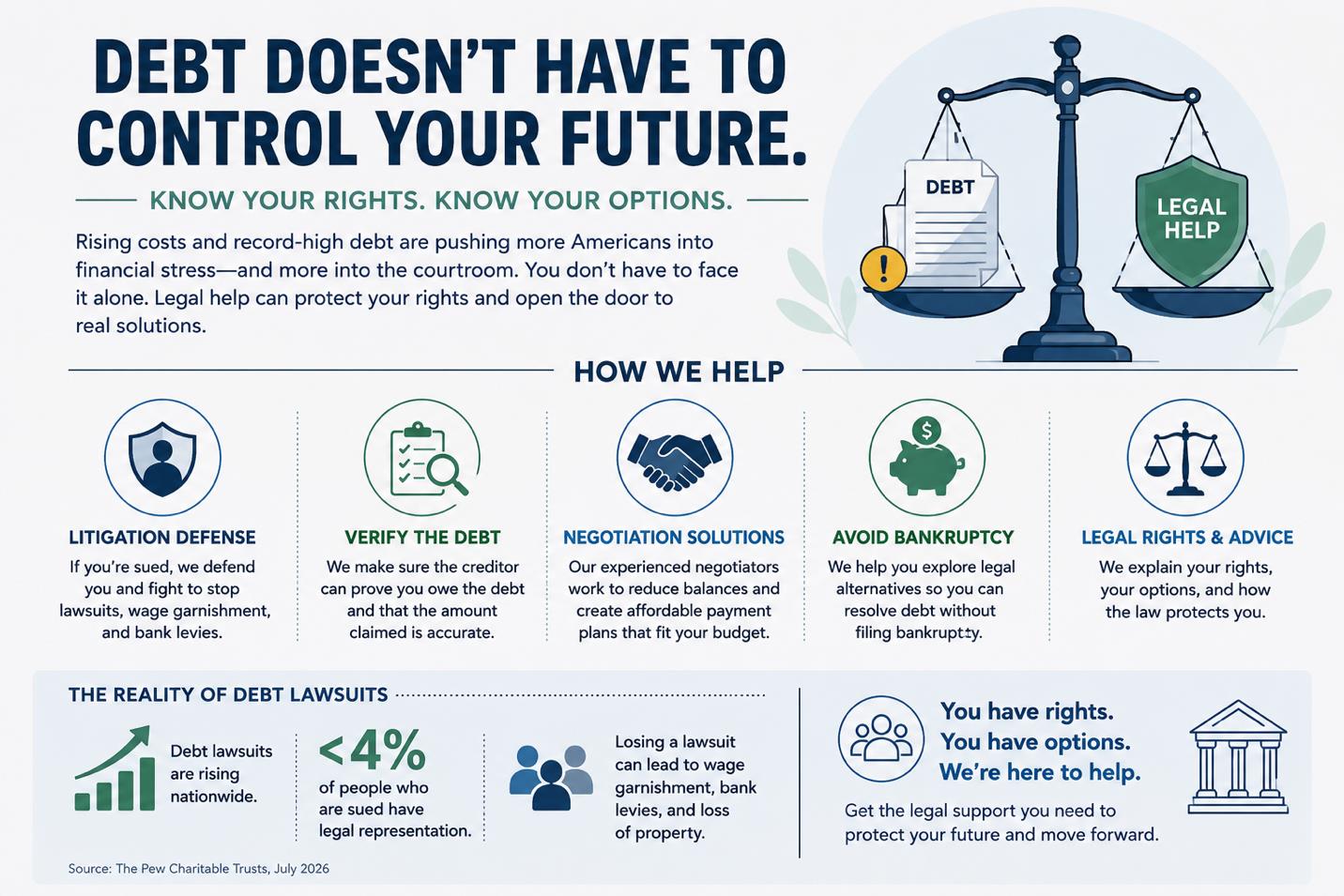
Across the country, millions of Americans are facing a financial reality they never expected. Rising prices for groceries, housing, insurance, and other everyday necessities have forced many families to rely on credit cards and loans simply to make ends meet. According to a July 2026 report by The Pew Charitable Trusts, Americans are accumulating what researchers call “survival debt”—debt incurred not for luxury purchases, but to pay for basic living expenses.
As consumer debt reaches record highs, another troubling trend is emerging: debt collection lawsuits are increasing at an alarming rate.
Pew found that debt lawsuits continued their upward trajectory throughout 2025, with filings increasing rapidly in states and cities across the country. In Utah, debt lawsuits are on pace to exceed the levels seen after the Great Recession. Alabama has already reached its highest number of debt lawsuits on record. Similar increases have been seen at the local level, with counties such as St. Louis County, Missouri, and Suffolk County, Massachusetts, reporting debt lawsuit filings dramatically higher than before the pandemic.
Unfortunately, most consumers face these lawsuits alone. According to Pew, fewer than 4% of defendants in debt collection cases have legal representation.
That statistic should concern anyone struggling with debt.
Many people assume that debt problems are purely financial and that the solution is simply to negotiate a lower payment. While negotiation is important, debt often presents significant legal issues as well. Creditors may file lawsuits, seek wage garnishments, freeze bank accounts, or pursue judgments that can follow consumers for years. Before agreeing to pay a debt, consumers should also understand whether the creditor can legally prove ownership of the account, whether the amount claimed is accurate, and whether the debt is still legally enforceable.
These are legal questions—not simply financial ones.
Attorney Naomi Sarega explains: “One of the biggest misconceptions we see is that people believe they have only two choices: pay whatever the creditor demands or file bankruptcy. In many cases, there are other legal options. Before agreeing to pay, consumers should understand whether the debt is valid, whether the amount is correct, and what defenses may be available. Our goal is to help clients resolve debt in the most effective way while protecting their legal rights.”
At Higbee & Associates, our approach is designed to address both the financial and legal aspects of debt. Our goal is to help clients resolve their debts without the need to file bankruptcy whenever possible. Every situation is different, and bankruptcy may be appropriate in some cases, but many consumers have alternatives that deserve careful consideration before making such a significant decision.
Our attorneys review each client’s situation to help determine the best legal strategy. We help clients evaluate whether they actually owe the debts being asserted, identify potential legal defenses, and explain the legal rights available under federal and state law. If a creditor files a lawsuit, our litigation team is available to defend eligible clients, helping protect them from default judgments and ensuring that creditors are required to prove their claims.
At the same time, our experienced negotiation team works to reach practical resolutions with creditors. By negotiating reduced balances and affordable payment arrangements, we seek solutions that fit our clients’ financial circumstances while bringing them closer to becoming debt free. Every negotiated resolution is approached with the goal of providing an efficient, realistic path toward financial recovery.
The consequences of ignoring debt litigation can be severe. Pew highlighted the case of a widower who, while struggling with medical bills after his wife’s death, unknowingly agreed to give a hospital $23,000 from the future sale of his home. Another consumer had 25% of her wages garnished for weeks because of a utility bill she did not even realize was outstanding. These situations illustrate how quickly debt problems can become legal problems with long-lasting consequences.
Consumers facing financial hardship deserve more than collection calls and settlement offers. They deserve experienced legal professionals who can explain their rights, defend them when necessary, and pursue practical solutions that help them move forward.
“Our expert legal work does stop and resolving the debt. We help make sure that credit reports are properly updated so that the client can start improving his or her credit score and obtaining favorable access to credit,” says Sarega.
If mounting debt has become overwhelming, the earlier you seek legal guidance, the more options you may have. Understanding your legal rights before a lawsuit is filed—or responding quickly after one is filed—can make a significant difference in protecting your finances, your property, and your future.
By Mathew Higbee, Founding Attorney
Mathew Higbee has been working with clients struggling with debt financial issues since 2006. He has represented clients in courts across the country in matters involving debt collection, wrongful eviction, creditor harassment and fair credit reporting cases.
Published July 19, 2026
Reviewed July 20, 2026